HydroPod 2.0Rethink Water Access
From water collection to water intelligence.
From time poverty to opportunity.
HydroPod 2.0 is a next-generation development concept for decentralised water access. It challenges the assumption that water infrastructure must be fixed, centralised and disconnected from the everyday realities of the communities it serves.
Where this project stands
Concept stage: the need, the solution and the delivery model are defined. The next step is validation with technical, site and funding partners.
Where it sits in the BRC Nexus
- Water
- Energy
- Food
- Water Mobility
- Commerce
What if water access could be designed around people, not simply around infrastructure?
The time poverty challenge
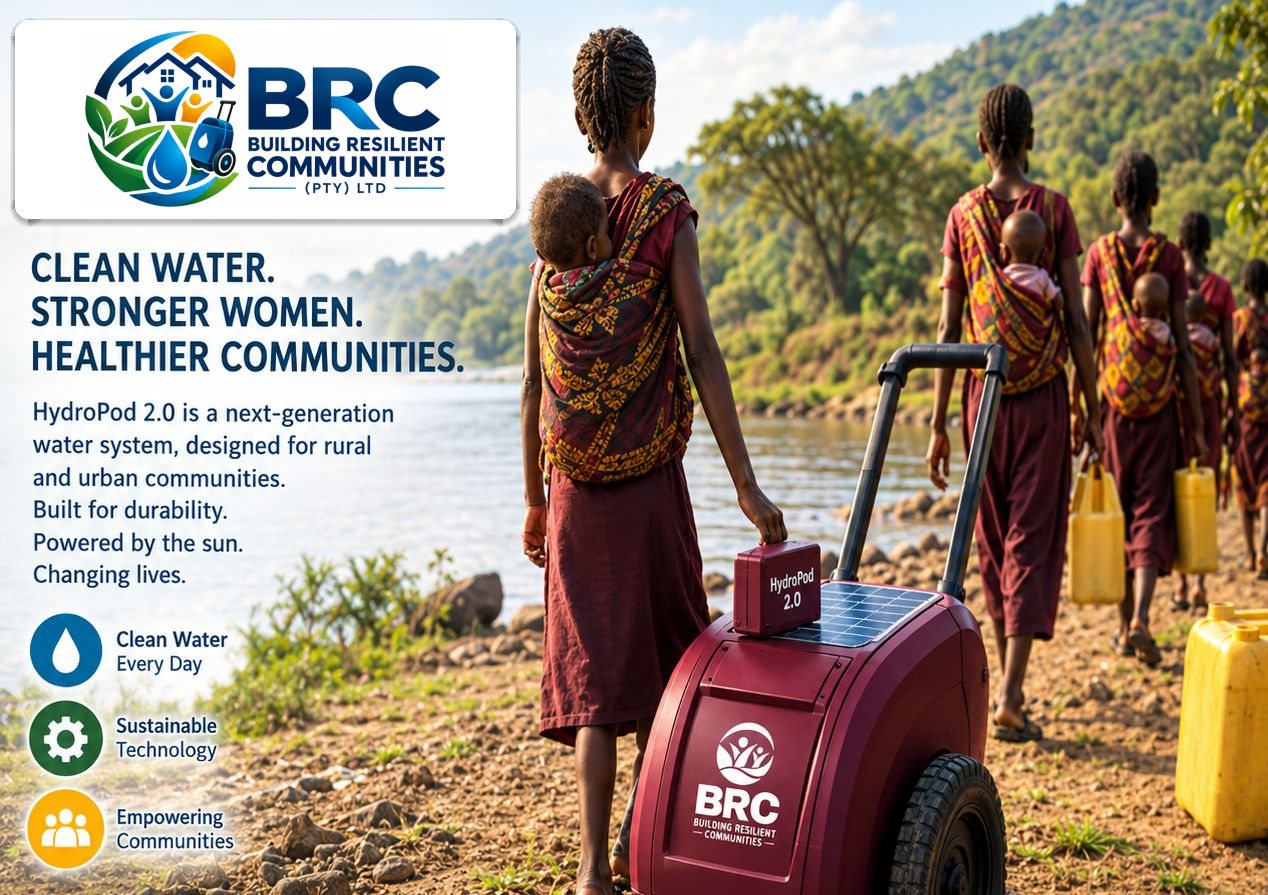
Water access is about more than litres delivered. It is also about the hours people spend obtaining water, the physical burden of carrying it and the opportunities lost in the process, particularly for women, caregivers and vulnerable households. Time returned can create opportunity, but only when water is reliable, accessible, safe and available where people need it.
An integrated water-access platform
- Solar energy Renewable power for selected system components.
- Water storage Accessible, appropriately sized storage capacity.
- Water treatment Treatment designed around verified source-water conditions and required quality standards.
- Smart monitoring Sensors that track selected operating conditions and system performance.
- Connected services Digital interfaces for reporting, maintenance, access management and operational data.
Features describe the intended design of a concept. The image is an AI-generated concept, not a built unit.
Where it could be used
- Household and community water access
- Cold storage for community health workers and rural produce
- Small mobile enterprises for women and youth
Designed for Africa
HydroPod 2.0 is designed for rural and urban communities across the continent: built for durability, powered by the sun, and designed to give people back time, dignity and opportunity.
The next step is a prototype
Engineering design, treatment performance, water quality, storage capacity, energy requirements, operating costs, maintenance arrangements and user access models must be validated before deployment. The next step is a technically assessed prototype, followed by controlled testing and a pilot at a suitable site.
Where partners can contribute
- Engineering and system integration
- Prototype development and testing
- Water-treatment and quality validation
- Solar, sensor and digital technology integration
- Pilot implementation and performance measurement
BRC invites engineering firms, water-technology specialists, research institutions, technology developers and potential pilot-site partners.
Other partnership opportunities
HydroPod 2.0
Request the project brief, or start a conversation about a partnership.